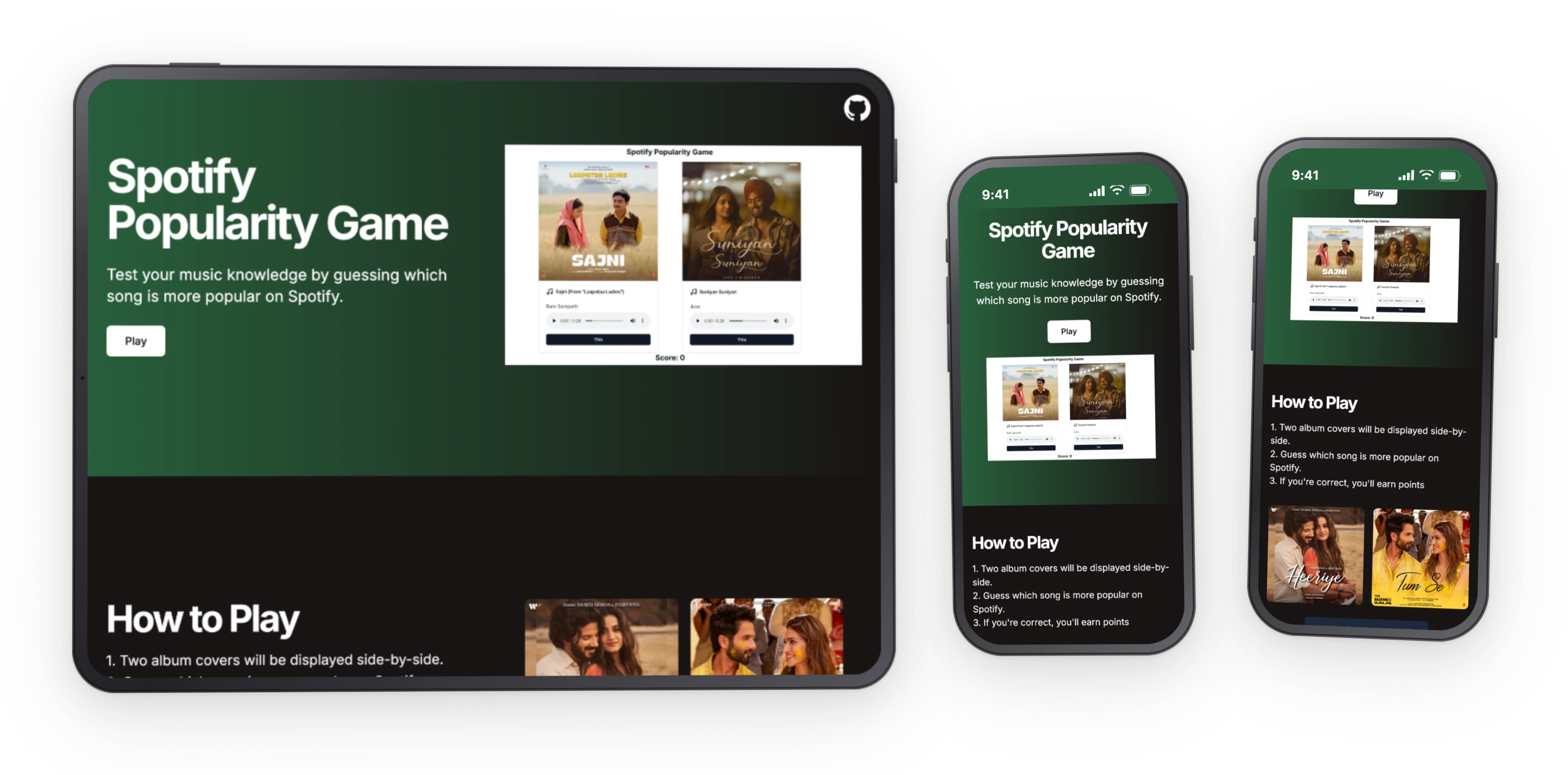
Here's a fun experiment in calibration: take two songs, show their album covers side by side, and ask "which one is more popular on Spotify?" It sounds trivially easy, until you play it and realize your intuitions about music popularity are wildly miscalibrated.
The game is simple by design. Two album covers appear. You pick the one you think has a higher popularity score on Spotify (a 0-100 metric based on recent play count and velocity). If you're right, you score a point and get a new pair. If you're wrong, game over. Your high score is a direct measure of how well-calibrated your sense of mainstream music taste is.
What makes this interesting from a design perspective is the tension between what you think is popular (based on your social circle, your playlists, your algorithmic bubble) and what's actually popular globally. A track that dominates your Discover Weekly might have a popularity score of 45. A song you've never heard of might be at 92. The game makes this gap visceral in a way that just looking at numbers doesn't.
Built with Next.js 14 and deployed on Cloudflare Pages. The Spotify Web API provides the track data, popularity scores, album art, artist info. The game state is entirely client-side, no backend needed beyond the initial API calls.
Built with
Links
Features
- Higher/Lower gameplay, guess which of two songs has a higher Spotify popularity score
- Real-time Spotify data, popularity scores pulled directly from the Spotify Web API
- Album art display, visual comparison using actual album covers
- Score tracking, see how well-calibrated your music taste intuitions really are
- Instant feedback, correct/incorrect with the actual popularity numbers revealed
- Zero backend, game state is entirely client-side, deployed as a static site on Cloudflare Pages
Challenges
The main challenge was curating the song pool. If you only use top-100 songs, the game is too easy, everyone knows Drake is popular. If you include obscure tracks, it becomes random guessing. The sweet spot is a mix: some mainstream hits, some genre-specific popular tracks, some viral TikTok songs, and some critically acclaimed but niche artists. Getting this balance right required iterating on the song selection algorithm and testing with real players.
What I learned
This project reinforced something I find fascinating: humans are terrible at estimating popularity outside their own bubble. We dramatically overestimate the popularity of things we personally like and underestimate things we've never encountered. The Spotify popularity score is a clean, quantitative measure of this bias. Building the game was straightforward, the interesting part was watching people play it and seeing their calibration improve over time.